
Tag: security technology

  • Private Security Agencies: A Comprehensive Guide to Professional Protection in 2026

    Private Security Agencies: A Comprehensive Guide to Professional Protection in 2026

    Professional security in 2026 is no longer defined by a person standing at a gate; it’s an integrated accountability ecosystem where human intuition meets high-level artificial intelligence. You’ve likely experienced the frustration of unreliable personnel who fail to arrive or provide zero visibility into their patrol activities, leaving your assets vulnerable and your legal liability dangerously high. When the stakes involve high-value construction sites or global events, the traditional watchman model is simply insufficient. Selecting from the top tier of private security agencies requires a shift in perspective, moving away from basic staffing toward a strategy of data-driven oversight and elite-level readiness.

    We recognize that you require absolute certainty in volatile environments. This guide demonstrates how elite firms now utilize AI-driven accountability and hospitality-grade standards to protect high-stakes assets while providing the transparency you’ve been missing. You’ll learn how to identify a licensed agency with proven experience in demanding sectors, implement modern technology for better oversight, and ultimately reduce your insurance liability through professional risk management. We’ll break down the specific mechanics of how modern agencies deliver on their promises, ensuring your critical information and assets remain secure.

    Key Takeaways

    • Understand the evolution of modern protection from traditional gate-watching to strategic risk management integrated with real-time data.
    • Identify how elite private security agencies leverage AI-driven accountability and hospitality-grade training to maintain unwavering standards at every post.
    • Explore specialized security protocols designed for high-stakes sectors, including luxury hospitality and large-scale construction site protection.
    • Learn the critical legal requirements for Florida-based firms, such as the Class ‘B’ license and the necessity of comprehensive general liability insurance.
    • Discover the operational advantages of partnering with agencies that possess a proven track record in managing global events and government-level security.

    What are Private Security Agencies and Why Do They Matter in 2026?

    Private security agencies are specialized firms that provide contractual protection, investigative services, and strategic risk management to individuals and corporations. While the historical definition of What is a Private Security Company often focused on static manpower, the industry has undergone a radical transformation. By 2026, these agencies have evolved from basic watchmen into sophisticated risk management partners that integrate human intelligence with advanced technology. They don’t just observe; they prevent, analyze, and mitigate threats before they escalate into major incidents.

    This evolution is driven by the increasing complexity of urban environments and the need for specialized oversight in high-stakes sectors. Modern private security agencies play a critical role in reducing corporate liability. By implementing rigorous protocols and maintaining substantial insurance coverage, such as the $5,000,000 general liability standards held by elite firms like Indemnity Security & Investigations, Inc., these agencies offer a layer of financial and operational protection that internal teams often can’t match. This professionalization directly impacts insurance premiums, as underwriters favor businesses that employ licensed, technology-driven security partners over those with unverified or passive staffing models.

    The Scope of Modern Security Services

    The capabilities of a premier agency extend far beyond a physical presence at a door. Comprehensive service portfolios now include:

    • Manned Guarding: Deployment of armed and unarmed security guards trained to hospitality-grade standards, ensuring professional interaction alongside vigilant protection.
    • Private Investigations: High-level discovery work including skip tracing, missing persons investigations, and discreet surveillance for legal or corporate needs.
    • Mobile Patrol Services: Randomized building sweeps and strategic perimeter checks that utilize GPS-verified reporting to ensure total site coverage.

    Public vs. Private Security: Closing the Gap

    In 2026, the line between public law enforcement and private security has blurred into a collaborative partnership. Private firms support law enforcement by managing specialized sectors like construction sites or large-scale events, allowing police resources to remain focused on broader community safety. A key differentiator for elite agencies is the use of FirstNet-enabled communications. This provides priority connectivity during emergencies, ensuring that private officers can communicate seamlessly when networks are congested. Businesses are increasingly opting for private agencies because they offer faster incident response times and a level of dedicated oversight that public resources simply can’t provide for private assets.

    The Anatomy of a High-Performance Security Agency

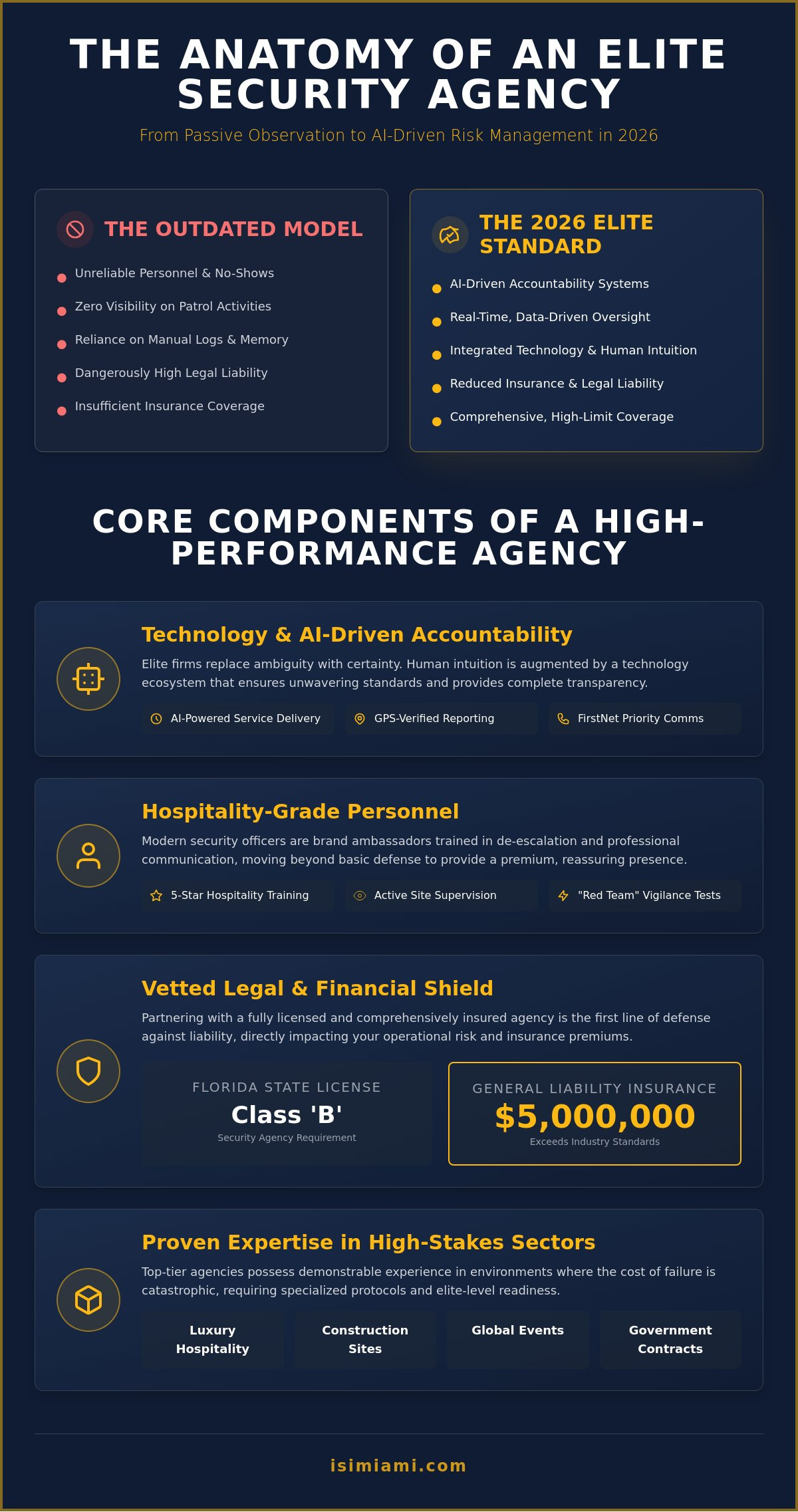
    Modern protection is a product of rigorous systems rather than individual effort. The evolution of the security industry has shifted the focus from simple staffing to AI-powered service delivery. Elite private security agencies no longer rely on a guard’s memory or manual logs. Instead, they implement a structured framework that combines human intuition with digital oversight. This systemic approach ensures that every officer on site understands their specific duties and remains active throughout their entire shift. Reviewing the capabilities of specialized security firms can help you determine if your current provider meets these 2026 standards.

    High-performance agencies prioritize “hospitality-grade” training standards. This model moves beyond basic defense to emphasize de-escalation, professional communication, and brand representation. Officers are trained to be as effective at assisting a guest as they are at identifying a security breach. To maintain these standards, professional private security agencies utilize unannounced quality assurance audits and active site supervision. These “red team” tests involve supervisors attempting to bypass security measures to ensure that personnel remain vigilant and compliant with site-specific protocols.

    Recruitment in this environment follows a stress-test model. High-stakes firms vet their personnel by deploying them first in high-pressure environments, such as Formula 1 Miami or Super Bowl events. Only those who demonstrate composure and precision in these volatile settings are cleared for permanent placement at luxury resorts or government facilities. This ensures that when an incident occurs at your site, the officer responding has already been tested in a high-intensity scenario.

    AI and Technology Integration

    Technology is the backbone of modern workforce management. High-performance agencies use AI Rules Assistants to provide officers with instant, voice-activated access to site protocols. If an officer encounters a specific incident, the AI provides the exact response steps approved by the client. Geofenced clock-ins prevent “ghosting” by ensuring personnel are physically on-site before they can begin their shift. Platforms like Belfry Software facilitate this by requiring randomized anti-inactivity check-ins, which force guards to interact with their devices at set intervals to prove they are awake and patrolling. Because these digital systems rely on functional hardware, it is wise to explore IPG Phone camera lens protector and other advanced shielding to prevent equipment downtime during active duty.

    The Accountability Stack

    The Accountability Stack is the combination of physical presence and digital verification. It eliminates the “he said, she said” of traditional security reporting. Every patrol route includes scanned checkpoints that generate GPS-stamped completion records. This data feeds into Daily Activity Reports (DAR) and instant incident notification systems, giving clients real-time visibility into their security posture.

    • GPS-Stamped Patrols: Verifiable proof that every corner of a property was inspected at the correct time.
    • Instant Incident Notifications: Real-time alerts sent to stakeholders the moment a breach or safety hazard is logged.
    • Digital DARs: Comprehensive daily summaries that highlight trends, risks, and completed tasks without the risk of manual error.

    Tailoring Protection Across High-Stakes Sectors

    Professional private security agencies distinguish themselves by their ability to adapt operational protocols to the specific environment they defend. A luxury resort requires a vastly different approach than a secured government facility or a high-traffic construction zone. In 2026, the demand for specialized expertise has surpassed the need for generalists. Clients now seek partners who understand the nuances of their specific industry, ensuring that security measures enhance rather than hinder daily operations. This sector-specific adaptability is what separates elite firms from basic staffing services.

    Whether managing a temporary event or a permanent industrial site, the objective remains the same: the verification of every individual and the protection of every asset. High-stakes environments leave no room for error. Agencies must possess the operational depth to move from broad overviews to specific tactical details without a loss in quality. This requires a methodical approach to risk assessment that accounts for the unique vulnerabilities of each sector, from the regulatory requirements of government contracts to the brand-sensitive needs of luxury hospitality.

    Hospitality and Resort Security Standards

    In luxury hospitality and branded residences, the officer is often the first point of contact for guests. This requires a “hospitality-grade” standard that balances rigorous safety with a concierge-level presence. Effective loss prevention in these high-traffic environments involves discreet surveillance and proactive guest safety measures. For those managing premium properties, implementing Elite Security Services in Miami ensures that protection remains invisible but absolute. It’s about maintaining a safe atmosphere without creating an intrusive environment for residents or visitors. Officers are trained to identify threats while providing the high-level service expected in elite resorts.

    Construction and Industrial Site Hardening

    Beyond static sites, elite private security agencies manage the complex logistics of international festivals and sporting events. This includes crowd control and rapid-response capabilities for high-profile gatherings like the FIFA World Cup 26 or Formula 1 Miami. In the government sector, protection requires strict adherence to federal compliance standards. Firms leverage experience with high-profile clients, including FEMA and the White House, to manage facility security with the highest register of formality and legal compliance. Whether it’s a mobile patrol or a fixed post, the strategy is always rooted in the specific risks and regulatory demands of the sector.
    Private Security Agencies: A Comprehensive Guide to Professional Protection in 2026

    Vetting Private Security Agencies: A Florida Buyer’s Checklist

    Selecting from the numerous private security agencies in Florida requires more than a cursory review of a website. You must verify that the firm holds a valid Class ‘B’ Security Agency License issued by the Florida Department of Agriculture and Consumer Services. This license is valid for three years and is the foundational legal requirement for any company providing contractual security services in the state. Beyond the basic license, your due diligence should focus on the agency’s ability to absorb risk and maintain absolute accountability in high-stakes environments. They don’t just promise results; they provide verifiable data.

    Professionalism in this industry is often measured by the depth of an agency’s insurance and its commitment to transparency. While Florida law requires a minimum of $300,000 in general liability insurance for licensing, this is rarely sufficient for high-value assets. Elite firms maintain $5,000,000 or more in general liability coverage to ensure their clients are fully protected against the financial fallout of major incidents. When you vet an agency, you’re looking for a partner that treats your liability as their own.

    Legal Compliance and Licensing

    You need to understand the distinction between individual officer licenses and agency-level requirements. A Class ‘D’ license covers unarmed duties and requires 40 hours of training, while a Class ‘G’ license is for armed officers and requires an additional 28 hours of firearms training plus annual recertification. However, the agency itself must be properly structured under a Class ‘B’ license to manage these personnel. It’s non-negotiable for large-scale commercial sites to demand $5M+ insurance limits, including workers’ comp and commercial auto, to ensure total coverage across all operational vectors.

    Evaluating Operational Experience

    Ask for documented performance in high-pressure environments. An agency’s ability to scale personnel for massive events, such as Super Bowl LV or Formula 1 Miami, is a reliable indicator of their operational depth. You should evaluate their history of supporting federal agencies like FEMA or the White House. Reviewing a Comprehensive Guide to Event Security Management provides a framework for the questions you should ask regarding crowd control and emergency protocols. If you require a partner that meets these rigorous standards, contact ISI Miami to discuss your site-specific requirements.

    Finally, transparency is the final pillar of the vetting process. Ensure the agency uses real-time reporting and digital verification systems to eliminate gaps in patrol activity. If your organization has diversity spend goals, confirm the agency’s Minority Business Enterprise (MBE) certification. This allows you to meet corporate social responsibility targets while receiving the elite-level protection required for 2026’s complex threat landscape.

    Why Indemnity Security & Investigations (ISI Miami) is the Standard

    In a landscape of varying standards, Indemnity Security & Investigations (ISI Miami) defines the benchmark for private security agencies. With over 13 years of operational history and a leadership team possessing more than 25 years of specialized expertise, the firm operates with a level of precision that few can replicate. The agency’s tagline, “Proven Across Four High-Stakes Sectors,” is an operational reality rather than a marketing claim. ISI manages the distinct demands of Construction, Events, Hospitality, and Government with a unified standard of excellence that has earned them the title of NFL Super Bowl LV Vendor of the Year.

    A key differentiator is the application of a “Hospitality-Grade” philosophy to every environment, including rugged industrial and commercial sites. This approach ensures that security personnel are not only vigilant protectors but also professional representatives of the client’s brand. Whether securing the FIFA World Cup 26 or a multi-million dollar construction development, ISI personnel maintain a register of formality and ethical conduct that mitigates liability and enhances site safety. This commitment to quality has solidified their reputation as a trusted partner for high-profile entities, including FEMA and the White House.

    Elite Personnel and Training

    The strength of ISI lies in its rigorous recruitment and retention strategies. The agency utilizes high-pressure environments, such as Formula 1 Miami, to recruit and “stress-test” officers before they are cleared for fixed-site placements. This ensures that every officer assigned to a luxury resort or government facility has already demonstrated composure in volatile, high-intensity scenarios. ISI also prioritizes the welfare of its workforce through fair wages and holiday pay, resulting in significantly lower turnover rates than the industry average. This stability allows for deeper site-specific knowledge and more reliable protection. For clients requiring specialized details, the agency provides elite executive protection for VIPs and government officials, maintaining strict adherence to discretion and protocol.

    Strategic Technology Advantage

    ISI maintains a bold technological edge by integrating advanced systems into daily operations. As a forward-thinking leader among private security agencies, they utilize FirstNet communications to ensure priority emergency connectivity when standard networks fail. This is complemented by AI-driven surveillance and workforce management tools that provide 100% accountability for every post. Every patrol is verified, every incident is logged in real-time, and every officer has instant access to site-specific AI Rules Assistants. This combination of human intuition and digital verification eliminates the visibility gaps common in traditional security models. To secure your assets with this level of precision, contact ISI Miami for a comprehensive security consultation and experience the standard of professional protection.

    Establishing Absolute Certainty in a Volatile Future

    The security landscape in 2026 demands a shift from passive observation to active, data-driven risk management. You’ve seen how elite private security agencies integrate AI-powered accountability with hospitality-grade professionalism to secure luxury resorts, government facilities, and global events. Success in this environment depends on moving beyond basic staffing to verify substantial insurance coverage and a proven track record of performance under extreme pressure.

    Indemnity Security & Investigations (ISI Miami) represents the pinnacle of this evolution. As the Super Bowl LV NFL Vendor of the Year and an MBE Certified Minority Business Enterprise, we offer the operational depth your high-value assets require. Our use of FirstNet-enabled communications ensures 24/7 reliability even during major incidents when standard networks fail. It’s time to transition from traditional guarding to an integrated accountability ecosystem that protects your brand and reduces your total liability.

    Secure Your Assets with ISI Miami’s Elite Protection Services

    You deserve the peace of mind that only comes from a seasoned, technologically advanced partner. We’re ready to help you build a safer, more transparent future for your organization.

    Frequently Asked Questions

    What is the difference between a security agency and a guard service?

    A security agency provides a comprehensive risk management ecosystem, while a guard service typically focuses on raw manpower. Professional private security agencies integrate advanced technology, investigative expertise, and strategic oversight to manage client liability. This distinction is critical for high-stakes environments where simple standing guards aren’t enough to prevent complex threats. An agency acts as a strategic partner, offering specialized services like executive protection and site hardening that basic staffing firms cannot provide.

    How do private security agencies use AI to improve safety?

    AI improves safety by providing officers with real-time access to site-specific protocols and automating patrol verification. AI Rules Assistants allow personnel to query emergency procedures instantly, ensuring they follow approved response steps. AI-driven surveillance systems can detect unauthorized movement or safety hazards that might be missed by the human eye. This technology ensures 100% accountability, as geofenced clock-ins and anti-inactivity check-ins force a higher standard of performance throughout every shift.

    Are private security guards in Florida required to be licensed?

    Yes, all security officers in Florida must hold a valid Class D license for unarmed duties or a Class G license for armed positions. These licenses require mandatory training at state-approved facilities and background checks. The private security agencies employing these officers must also hold a Class B license. Choosing a licensed firm ensures that your security personnel have met the rigorous legal and training standards required by the state of Florida.

    What insurance limits should a professional security agency carry?

    A professional agency should carry a minimum of $5,000,000 in General Liability insurance to adequately protect high-value assets. While state law requires much lower limits for basic licensing, this higher threshold is essential for managing the liability associated with large-scale commercial or government sites. Comprehensive coverage must also include Workers’ Compensation and Commercial Auto insurance. These limits ensure that the financial burden of an incident doesn’t fall back onto the client or property owner.

    Can a private security agency provide investigative services like skip tracing?

    Licensed agencies with an investigative arm can provide specialized services, including skip tracing and missing persons investigations. These services utilize professional databases and surveillance techniques to locate individuals or verify information for legal and corporate clients. By combining physical security with investigative discovery, agencies offer a more complete solution for risk mitigation. This is particularly valuable for clients managing complex legal disputes or seeking to recover high-value assets in volatile environments.

    What is ‘hospitality-grade’ security and why does it matter for construction sites?

    Hospitality-grade security refers to a standard of training that prioritizes professional communication and brand representation alongside vigilant protection. For construction sites, this means that officers manage access control and contractor verification with a level of courtesy that reflects well on the developer. It transitions the role of a guard from a passive observer to a proactive professional. This approach reduces friction on-site while maintaining a rigorous security posture that prevents unauthorized entry and theft.

    How does FirstNet technology benefit private security operations?

    FirstNet benefits operations by providing priority and pre-emptive communication on a dedicated network built for first responders. This technology ensures that security teams can communicate seamlessly during emergencies or large-scale events when standard cellular networks are congested. By utilizing FirstNet, an agency guarantees that its officers remain connected to supervisors and emergency services without delay. This reliable connectivity is a cornerstone of rapid-response capabilities in high-pressure environments where every second matters.

    What should be included in a Daily Activity Report (DAR)?

    A Daily Activity Report must include GPS-stamped patrol logs, visitor access records, and detailed descriptions of any incidents or safety hazards. Modern reports are digital and provided in real-time to ensure full transparency for the client. These logs serve as a verifiable audit trail that proves the security plan was executed as designed. A comprehensive DAR is an essential tool for reducing insurance liability and maintaining operational oversight across multiple sites.
  • Comprehensive Guide to Event Security Management in 2026

    Comprehensive Guide to Event Security Management in 2026

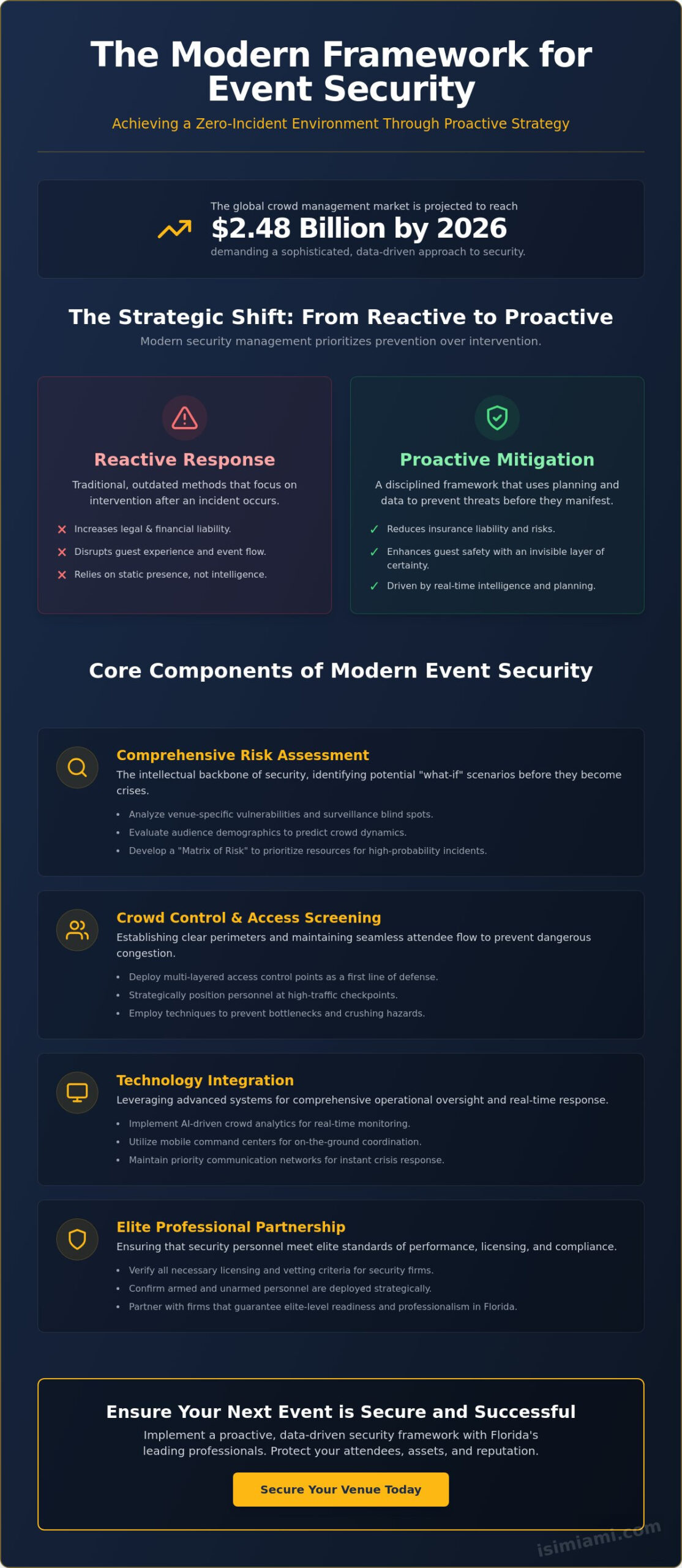
    With the global crowd management market projected to reach $2.48 billion in 2026, the scale of modern gatherings has outpaced traditional oversight methods. You likely recognize that a single communication breakdown or an unpredictable surge in a crowd can transform a successful activation into a significant legal and financial liability. Managing these high-stakes environments requires more than just a visible physical presence. It demands a sophisticated approach to event security management that integrates real-time data, elite-level readiness, and methodical planning to ensure every attendee remains safe.

    This guide provides the strategic frameworks necessary to achieve a zero-incident environment while effectively reducing insurance liability. You’ll master the complexities of modern risk assessment, learn to implement AI-driven crowd analytics, and discover how to maintain seamless attendee flow through advanced technological integration. We examine the transition from reactive response to proactive, data-driven oversight. These insights will empower you to coordinate large-scale gatherings with the absolute certainty that your safety protocols are both invisible to the guest and impenetrable to threats.

    Key Takeaways

    • Learn to transition from reactive responses to proactive risk mitigation by identifying specific venue vulnerabilities and potential threats during the planning phase.
    • Establish a zero-incident environment through the strategic deployment of armed and unarmed personnel at high-traffic checkpoints.
    • Integrate advanced technology, including mobile command centers and priority communication networks, to maintain comprehensive operational oversight.
    • Master the modern frameworks of event security management to effectively reduce insurance liability while ensuring a seamless flow for all attendees.
    • Identify the essential licensing and vetting criteria for professional security firms in Florida to guarantee elite-level performance and compliance.

    What is Event Security Management? Defining the Modern Framework

    Event security management represents the disciplined coordination of elite personnel and advanced operational systems to safeguard a specific venue, its assets, and its attendees. It’s no longer sufficient to rely on reactive policing, where security only intervenes after a disruption occurs. Modern safety demands a proactive framework. This approach prioritizes risk mitigation through meticulous planning, pre-event intelligence, and real-time data analysis. While general security often focuses on static asset protection, specialized event protocols must account for the fluid dynamics of thousands of people moving through a temporary and often high-pressure environment.

    The distinction lies in the specialized nature of these operations. A professional security manager balances the requirements of high-level protection with the expectations of hospitality. Security should act as an invisible layer of certainty that enhances the guest experience rather than obstructing it. This requires a methodical approach where every guard and every technical sensor serves a strategic purpose. Within the broader scope of event security management, success is measured by the absence of incidents and the seamless execution of the event’s primary objectives.

    The Scope of Event Safety in 2026

    The environments managed in 2026 range from expansive open-air festivals to high-profile corporate galas and government facility gatherings. Each venue presents unique vulnerabilities that a “one-size-fits-all” strategy cannot address. Protecting brand reputation is a primary driver for sophisticated security. A single incident can lead to catastrophic legal liability and long-term reputational damage for organizers. Complex modern venues require custom solutions that adapt to changing crowd densities, weather conditions, and environmental factors.

    Key Objectives of a Security Manager

    A primary objective is the establishment of clear perimeters and multi-layered access control points. These barriers act as the first line of defense against unauthorized entry or the introduction of prohibited items. Beyond physical boundaries, managers prioritize rapid response capabilities for both medical emergencies and security breaches. Time is the most critical variable in any crisis; therefore, communication lines must remain open and immediate.

    Effective management also focuses on maintaining consistent crowd flow to prevent dangerous congestion. By employing strategic crowd_control techniques, security teams can prevent the formation of bottlenecks that lead to crushing hazards or panic. The ultimate goal remains a seamless experience where attendees move safely from entry to exit without ever perceiving the rigorous oversight keeping them secure. This level of readiness ensures that the event’s focus remains on the experience, not the risks.

    Conducting a Comprehensive Event Risk Assessment

    Risk assessment serves as the intellectual backbone of professional event security management. It identifies potential “what-if” scenarios before they manifest as active crises. A thorough assessment looks past the obvious threat of unauthorized entry to consider medical emergencies, technical infrastructure failures, or sudden environmental shifts. By analyzing these variables during the planning phase, security managers can transition from a reactive posture to a state of elite-level readiness.

    Analyzing venue-specific vulnerabilities requires a methodical physical sweep of the environment. Much like the thoroughness required for a home inspection Indianapolis to ensure residential safety, security teams must identify blind spots where surveillance coverage is limited and evaluate whether exit routes can handle emergency surges without causing secondary hazards. Utilizing the Venue Guide for Security Enhancements provides a standardized framework for mitigating these physical and dependency disruptions, ensuring that the venue’s architecture supports the safety mission.

    Understanding the audience is equally vital for predicting crowd dynamics. Attendee demographics dictate potential friction points; a high-energy festival requires different management strategies than a high-profile corporate summit or a government facility gathering. By evaluating these factors, we establish a Matrix of Risk. This tool prioritizes resources for high-probability incidents, ensuring that specialized personnel are positioned exactly where they are needed most. For organizers managing complex sites, partnering with experts in Event Security & Crowd Control ensures these assessments are backed by field-tested experience.

    Venue Scouting and Perimeter Integrity

    Mapping physical boundaries is the first step in establishing total site control. We identify weak entry points, such as unsecured service doors or inadequate fencing, and reinforce them with personnel or technology. Lighting and signage act as critical tools for both deterrence and navigation, directing the flow of people away from restricted zones. In Florida, coordinating with local law enforcement for external perimeter support ensures that the transition between public space and the secured venue remains seamless and professionally managed.

    The Incident Response Plan (IRP)

    An Incident Response Plan (IRP) is the blueprint for immediate action during unforeseen disruptions. A robust IRP utilizes a tiered response strategy to address various breach levels. While a minor disruption might only require a quiet intervention, a significant threat triggers a venue-wide lockdown or evacuation. Defining a clear chain of command is essential to prevent communication silos during high-pressure moments. When every team member understands their specific role, the response remains calm, methodical, and effective.

    Essential Components of Crowd Control and Access Screening

    While ticket scanning is a logistical necessity, it represents only a fraction of a robust security posture. Effective event security management requires a multi-layered physical barrier that begins long before a guest reaches the turnstile. This framework starts with the strategic deployment of personnel. We utilize a calculated mix of armed and unarmed security guards at high-traffic checkpoints. Unarmed guards typically manage primary screening and guest interactions, while armed personnel provide a secondary layer of elite protection at critical ingress points. Their “passive presence” is a deliberate tactic. By maintaining high visibility in professional attire, guards influence attendee behavior subconsciously, discouraging illicit activity through the sheer perception of constant oversight. This level of professional presence is a hallmark of specialized firms; for example, Stormhammer Security, Inc. provides licensed unarmed guards and mobile patrols that prioritize both guest safety and the overall event atmosphere.

    The most volatile moments of any gathering occur during the transition phases. Managing “load-in” and “load-out” requires clinical precision to prevent crushing and congestion. Security teams must actively direct movement, ensuring that exits remain unobstructed and that the surge of departing guests doesn’t create dangerous bottlenecks. Federal resources on securing public gatherings emphasize that these transitional periods are when situational awareness must be at its peak. Vigilance during these windows prevents the types of mass-motion incidents that lead to organizer liability.

    Advanced Access Screening Protocols

    Modern venues integrate multi-layered screening, including walk-through metal detection, physical bag checks, and RFID validation. For VIP and backstage areas, biometric technologies ensure that only verified personnel enter sensitive zones. Credentialing serves as the foundation for internal perimeter integrity. The challenge lies in balancing thoroughness with operational efficiency. A frustrated queue is a security risk in itself. Therefore, we deploy high-throughput screening systems to maintain speed without sacrificing safety, ensuring that the entry process remains professional and orderly.

    Psychology of Crowd Control

    Uniform visibility acts as a psychological deterrent, but professional de-escalation tactics are the primary tools for preventing violence. In high-energy environments or where alcohol is served, security must intervene with clinical precision before a minor dispute escalates. We deploy “floater” guards who move through the crowd to monitor density in real-time. These mobile units identify emerging “hot spots” and coordinate with the command center to redistribute personnel. This proactive movement ensures that crowd pressure never reaches a critical threshold, maintaining a safe environment for every participant.

    Comprehensive Guide to Event Security Management in 2026

    Technology Integration: Mobile Command Centers and Communications

    Modern event security management relies on a sophisticated technological infrastructure to maintain situational awareness across vast venues. Physical patrols alone often leave gaps in oversight. We bridge these gaps by deploying integrated systems that transform raw data into actionable intelligence. AI-driven surveillance monitors crowd density and movement patterns, flagging anomalies before they escalate into physical incidents. These systems provide a level of vigilance that human observation can’t achieve alone. This allows for surgical interventions in specific zones without ever disrupting the overall event flow. It’s about seeing what the human eye misses.

    The Mobile Command Center Advantage

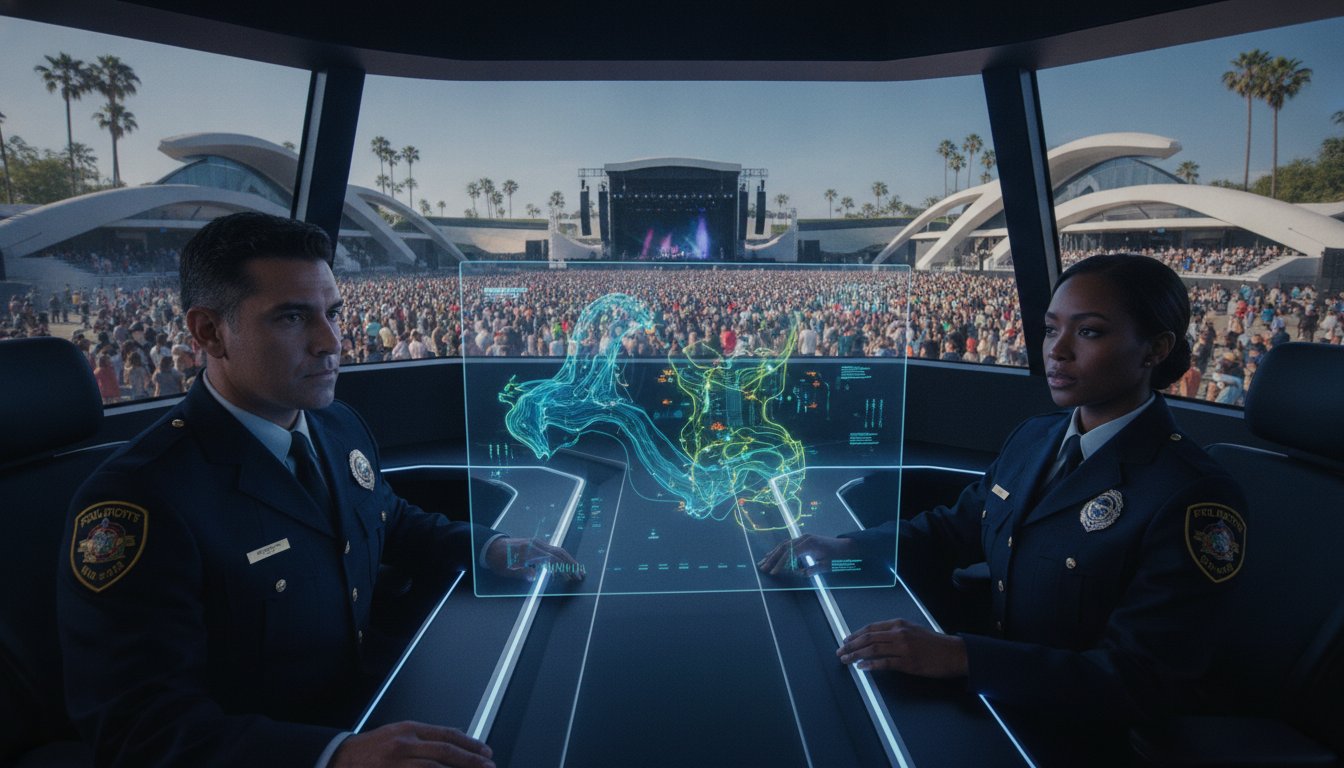
    A Mobile Security Command Center serves as the brain of any large-scale security operation. By centralizing video feeds, radio traffic, and emergency dispatch into a single hub, we provide organizers with a unified operational view. This centralization eliminates the delays caused by fragmented information. Instead of multiple siloed teams, the command center ensures every guard, medic, and technician receives the same real-time updates. It acts as the single point of contact for safety operations. Decisions are made with the full context of the site’s environment, ensuring a methodical response to any developing situation.

    Reliable Comms: FirstNet and Beyond

    Standard cellular networks often fail during crowded events as bandwidth becomes saturated by attendee usage. In high-stakes environments, communication failure isn’t an option. We leverage FirstNet-enabled communications to provide our teams with priority network access. This dedicated band ensures security transmissions remain clear and uninterrupted even during peak congestion. It also facilitates seamless interoperability between private security and public emergency services. This is vital for a coordinated response during a crisis. Whether managing a sprawling festival or a dense urban gala, ensuring 100% coverage is the foundation of our elite-level readiness.

    Accountability systems further refine our operational depth by tracking guard patrols and incident reports in real-time. This digital audit trail ensures every sector is monitored according to the pre-established risk assessment. Response times are measured with precision. Guards use mobile incident reporting platforms to document activities with timestamps and GPS data, providing total transparency to the organizer. These data-driven strategies allow us to deliver a higher standard of safety that traditional methods simply can’t match. If your upcoming project requires this level of strategic oversight, contact us to discuss our Mobile Patrol Services and Event Security solutions.

    Partnering with Professional Event Security Companies in Florida

    Professional event security management in Florida requires strict adherence to state regulatory standards. It’s not enough to hire a firm with a general presence; you need a partner that understands the specific legal and operational nuances of the Sunshine State. Florida law mandates that all security personnel hold a Class D license, which requires 40 hours of professional training. For environments requiring higher levels of deterrence, armed guards must also possess a Class G license. Hiring an unlicensed firm doesn’t just compromise safety; it creates a massive legal liability for the event organizer. Choosing a partner with these credentials ensures that every guard on your site meets the state’s rigorous performance and ethical standards.

    For corporate and government contracts, partnering with a Certified Minority Business Enterprise (MBE) provides significant added value. These certifications often help organizers meet diversity spend requirements while ensuring they receive elite-level service. Beyond the paperwork, the right firm brings specialized experience in sectors like hospitality, government facilities, or large-scale festivals. A firm that excels at construction site protection might not have the clinical de-escalation skills needed for a high-profile resort gala. You must vet your partner based on their proven track record in your specific industry to ensure their protocols align with your event’s unique atmosphere.

    Vetting Your Security Partner

    Vetting a security provider in South Florida requires a methodical look at their past performance. Use this checklist to evaluate potential partners:

    • Licensing and Insurance: Verify active Class D and G licenses and ensure their insurance coverage includes comprehensive liability for large-scale events.
    • Training Standards: Ask about their internal training for armed vs. unarmed personnel, focusing on use-of-force protocols and de-escalation.
    • Local Market Knowledge: Ensure the firm understands the specific logistics of Miami or Fort Lauderdale venues, including local law enforcement coordination.
    • 24/7 Support: Confirm they have a dedicated operational hub to manage rapid-response needs during the event.

    Local knowledge is indispensable. A firm rooted in the Florida market understands how to manage the environmental and social variables unique to this region, from sudden weather shifts to high-density urban crowd dynamics.

    Why ISI Miami is the Standard for Event Management

    Indemnity Security & Investigations, Inc. represents the standard for elite readiness in Florida. Our approach integrates advanced database intelligence with field-proven guard services to create a safety net that’s both robust and discreet. We have extensive experience managing high-profile hospitality environments and large-scale festivals where the balance between guest experience and absolute safety is critical. Our guards aren’t just a physical presence; they’re the front line of a data-driven strategy designed to prevent incidents before they occur. We prioritize accountability and transparency, providing organizers with real-time reporting and a clear chain of command. Secure your next event with Indemnity Security & Investigations, Inc. to ensure your safety protocols are managed with professional precision.

    Securing the Future of Large-Scale Gatherings

    Effective event security management in 2026 relies on the seamless fusion of elite personnel and innovative technology. We’ve explored how proactive risk assessments and multi-layered screening protocols create an invisible yet impenetrable safety net for attendees. By prioritizing data-driven oversight and clear communication through priority networks, organizers can significantly reduce liability while maintaining a fluid guest experience. This methodical approach ensures that every variable is accounted for before the first guest arrives.

    As a Certified Minority Business Enterprise (MBE) with offices in Miramar and Orlando, Indemnity Security & Investigations, Inc. provides the local expertise and elite readiness required for Florida’s high-stakes environments. We utilize FirstNet-enabled mobile command centers to ensure 100% operational coverage, and our teams are fully Florida licensed and insured. Don’t leave your safety strategy to chance. Request a Comprehensive Event Security Consultation today to ensure your next gathering is defined by its success, not its risks. We look forward to helping you build a zero-incident environment where your guests feel both welcome and protected.

    Frequently Asked Questions

    What is the ratio of security guards to attendees for a large event?

    The industry standard for low-risk gatherings is typically one guard for every 100 attendees. This ratio serves as a baseline and must be adjusted according to your specific risk assessment. High-energy festivals or events serving alcohol often require a higher density of personnel, such as one guard for every 50 or 75 guests, to maintain effective oversight and rapid response capabilities.

    Do I need armed or unarmed security for my corporate event?

    Most corporate environments prioritize a professional, welcoming atmosphere and primarily utilize unarmed security for access control and hospitality. Armed guards are typically reserved for high-profile executive protection or securing sensitive perimeters at government facility events. A hybrid approach often provides the best balance, with unarmed guards managing guest interactions while armed personnel remain positioned at critical ingress points.

    How does event security management reduce my insurance premiums?

    Comprehensive event security management reduces insurance premiums by demonstrating a proactive commitment to risk mitigation. Insurers often offer lower rates to organizers who present a documented Incident Response Plan and utilize licensed, insured security firms. By reducing the statistical probability of accidents or violence, you lower the financial risk for the carrier, which can result in more favorable policy terms.

    Can security companies in Florida help with local permitting and compliance?

    Professional security firms in Florida assist with compliance by ensuring your safety plan aligns with local fire codes and municipal ordinances. We coordinate with local law enforcement and fire marshals to verify that exit routes, occupancy limits, and perimeter barriers meet all legal requirements. This local market knowledge prevents costly delays during the permitting process and ensures the event remains compliant throughout its duration.

    What happens if there is a medical emergency at the event?

    Security personnel immediately initiate the medical portion of the Incident Response Plan and clear a path for on-site medical teams. Guards secure the immediate area to provide privacy for the patient while maintaining crowd flow elsewhere. They use priority communication channels to coordinate with local emergency services if a transport to a hospital becomes necessary, ensuring the response is calm and methodical.

    What is the role of a mobile command center at a festival?

    A mobile command center serves as the central intelligence hub, consolidating video surveillance, radio traffic, and real-time data analytics. It provides security managers with a 360-degree view of the entire festival grounds, allowing them to detect crowd density issues or security breaches immediately. This centralized oversight ensures that responses are disciplined and that resources are deployed exactly where they’re needed most.

    How do you handle uninvited guests or gate-crashers effectively?

    We manage unauthorized entry through multi-layered perimeters and rigorous credentialing at every access point. If a gate-crasher is identified, guards use professional de-escalation tactics to escort the individual off-site without disrupting the event’s atmosphere. For larger groups attempting to breach a perimeter, we deploy rapid-response units to reinforce the area and prevent a mass-entry incident before it escalates.

    What is the difference between crowd management and crowd control?

    Crowd management is the proactive planning of attendee movement, including the design of entry points and signage to encourage orderly flow. Crowd control refers to the reactive techniques used to manage a group that has already become disorderly or reached a dangerous density. Effective event security management prioritizes management strategies to minimize the need for physical control interventions and maintain a safe environment.